Showing posts with label Vintage Reports. Show all posts

Wednesday, April 20, 2011

Summerhouse 2011 Harvest

Heather Davies is one half of a husband and wife team that own, nurture and produce the highly accoladed Summerhouse wines from Marlborough, New Zealand. Here she shares here insights into the 2011 vintage.

This is the season where all of the decisions made over the last 16 years have shone through and with continued commitment to every step of the annual cycle within the vineyard we have achieved exceptional results.


16 years ago, we choose the Summerhouse vineyard site because of its unique combination of soil, aspect and climate. We chose the grape varieties, clones and rootstock's to complement those natural features. We have engaged cultural practices in the vineyard that ensure healthy vines that in turn give us physiological ripeness of the fruit. By achieving this we have the best quality raw product (the grapes) to make wines with a distinct sense of place.


The 2011 season has been an exceptionally busy one. The La Nina weather patterns that have developed over the Pacific Ocean have given us a cool spring, hot summer with good rainfall, and a cool autumn. This has meant all of the growth phases that the vines go though during the season have occurred over a shorter period.


The cool spring resulted in the canopy being poorly developed by mid November at flowering time. The weather changed to give a dry, warm flowering that resulted in good fruit sets. Throughout summer the heat continued and so did the growth. This gave us ample leaves in the autumn to ripen the crop. It also gave us good berry growth.


Each year we carry out crop sampling in early January and from this we make decisions on whether or not we need to thin off some of the fruit. A combination of a warm dry flowering period, warm rain in December, and strong healthy vines meant our decision this year was to carry out a crop load thin in January, followed by a tail end thin in March.


The decisions paid off when we came into autumn and the cool weather returned. The healthy open canopy, the reduced crop and the warm summer days had put us on track for an early harvest. We harvested the various blocks about 5 days earlier than in an average season.


We picked fruit starting with the Gewurztraminer on the 21st March and finished with the Riesling on the 3rd April. The first ferments are dry (the sugar has turned to alcohol), the later ones are currently mid way through. There is still a lot to do in the winery – I am looking forward in particular to seeing the aromatic varieties Sauvignon Blanc, Gewurztraminer and Riesling develop over the next few months.

Heather Davies
Summerhouse Wines
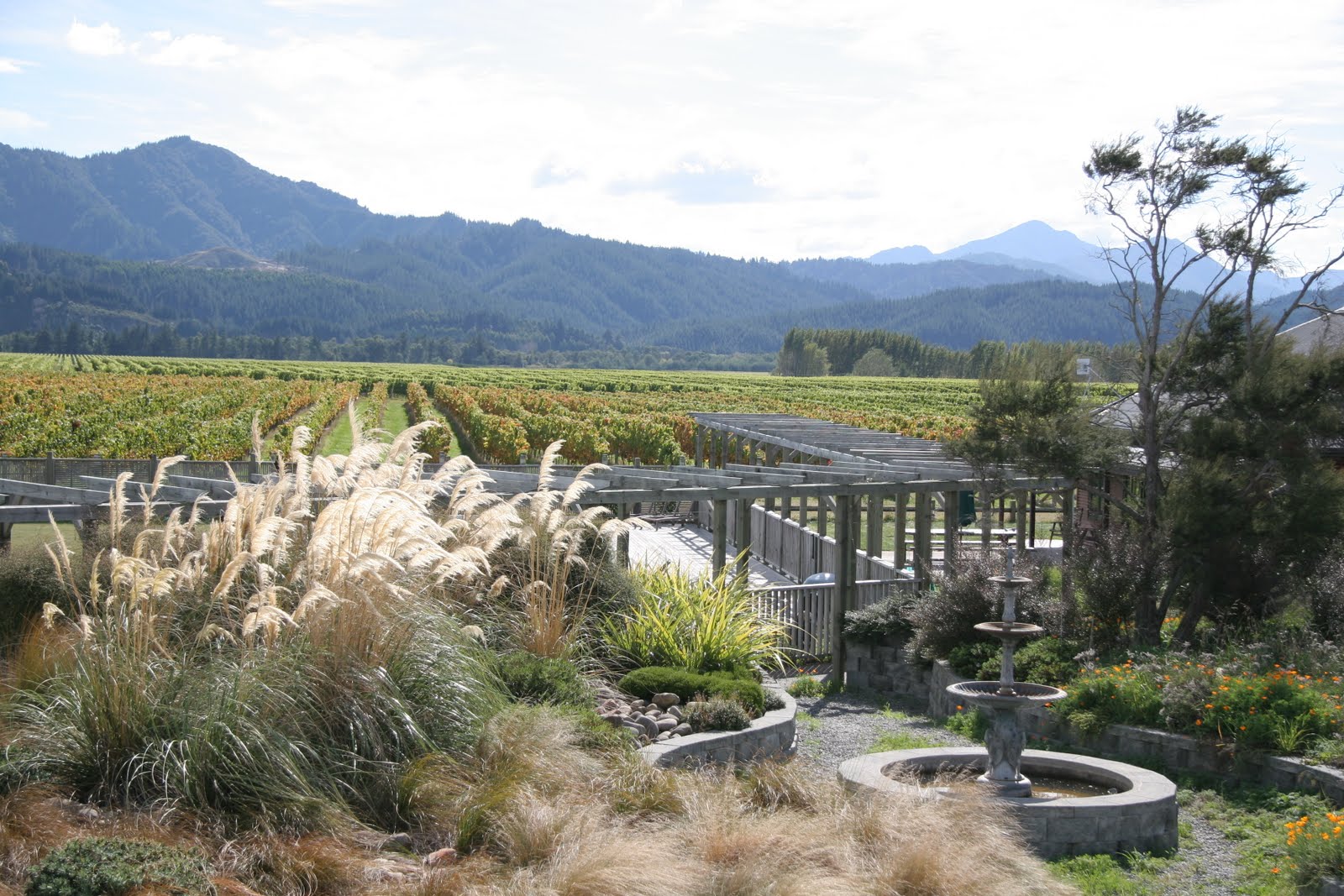

The Vineyards at Summerhouse

Heather & Meric Davies


Monday, July 26, 2010

Summerhouse wines 2010 vintage news.

The team at Summerhouse wines in New Zealand have been working hard lately in some pretty cold conditions as well. Here is the latest information they had on the 2010 harvest and other happenings around the vineyard.

     2010 Harvest News
This years harvest was a fairly relaxed time. We were blessed with fantastic weather so all the fruit was picked and in the winery before the late autumn rain set in. The fermentations have now come to an end and the labour intensive process of lees-stirring has started.
This is Heather and Meric's 12th harvest at Summerhouse. "So to the end of another harvest at Summerhouse" comments Meric. "The cool, slow start to the year was followed by perfect summer and autumn weather conditions that enabled us to pick individual parcels of fruit when they were ready. The fruit was clean, bunch sets were perfect and the yields were spot on. So far 2010 is looking like a fantastic vintage for Marlborough and Summerhouse."
Now we are about a quarter of the way through the long but important process of pruning the vines. We carefully prune the Summerhouse vines to ensure quality and even ripening in next years fruit. 

Wine Making News
We have some new additions to the barrel hall this year - French oak Pungeon barrels. These are the largest barrels we use and hold 500 litres. They will add warm sweet oak flavours to the chardonnay.


We will have a more detailed report on the vintage as soon as they get the chance to jot down a few words.

Thursday, February 11, 2010

From the Glass of Tim Burvill

Many articles have been written about the current oversupply issues the Australian Wine Industry is facing at the moment so I contacted RockBare wine maker Tim Burvill to see if he could give us a 'grass roots' perspective on this situation. Tim was kind enough to drag himself away from a poolside McLaren Vale Chardonnay and share his views.
The issues of the AWI have been well documented by the mainstream media over the past 12 months.  So, without going into too much detail, we have a situation where the annual grape harvest (in 2010 it is predicted to be 1.8 million tonnes or 140 million dozen) is about 30% above requirements.  The area of grapevines planted in Australia doubled between 1997 to 2007 to 164,000 hectares, and such a massive increase in plantings has lead to a predictable surplus.  Compounding the problem has been the over-dependence of the AWI on a few large players which got bigger and bigger every few years as mergers and acquisitions took place (and might I add, most at completely over-inflated prices).  Throw in a global financial crisis, an appreciating Australian dollar, huge write-downs on the recent acquisitions,  and coupled with the inability of these large Australian wine corporations to be able to effectively market a sell large and diverse wine brand portfolio's, and we find our self in our present position. 
It will be very interesting to see how all of this plays out.  Grape growers are the ones really bearing the brunt of the industry's problems.  Since the large wineries, which were taking the majority of the crop previously, have opted out of the grape market, most grape growers coming out of contract are struggling to find a home for their fruit.  This in turn is resulting in very low fruit prices being offered by these out-of-contract grower.  How long will these growers be able to sustain growing crops in which they lose money on?  We will undoubtedly see vineyard pulled out, particularly in the newer grape growing regions that lack strong brands competing for their fruit.
The other sector of the industry hurting is the small wineries which were reliant on selling a container or two of wine to the USA and UK every year.  These sales for the most part have ground to a halt, and causing cash-flow and over-stock issues.  This is further exacerbating the low grape prices, as these smaller wineries which for the most part played in the high-priced fruit sector, also opt out of the grape market whilst they concentrate on selling through the stock in their warehouse.
 All sounds pretty grim doesn't it?  Well, it's not all doom and gloom.  In fact, some Australian wine companies have never had it better.  Wineries with strong brands, and solid finances are finding their market share increasing.  Yes, you read correctly, increasing.   We are are seeing a period of strong brands cementing their position in the market, and improving their footprint as they ride above the price-discount melee occurring below them.  Indeed, quality fruit has never been cheaper, nor have growers ever been more inclined to grow and crop their fruit as the wineries wish them to.  A New World Order is being created in the AWI at present.  For the most part, 2nd, 3rd, 4th and 5th generation family owned wine companies are the ones charging ahead.  They have seen all of this before (crashes in the industry) and for the most part are well prepared.  They still offer the consumer a product with integrity- from who owns it, to who makes it, and that their brand cannot be found being trashed in the big supermarkets.   Also on the rise are the wineries who have partnered with importers/distributors on their brand.  These type of relationships give both the winery and the sales partner the confidence to invest additional time, focus and marketing dollars to the brand.  I think it will be very rare moving forward for any new brands to be solely owned from vineyard to the brand.  The capital requirement and risk is simply too high to make it a viable in the ultra competitive world wine market.
 One thing can be certain as we charge into the 2010 harvest.  By the end of this year, we will be operating in a very different market to the one we started the year in.
 Cheers
Tim

If you have an opinion on the subject please feel free to post it here and if you have anything you would like wine makers to answer please feel free to ask.

Dean

Tuesday, February 2, 2010

2009 Vintage Report Ribera del Duero

I recently asked the hardworking team at Valduero in the Ribera del Duero, Spain, if they could give us some insight into the 2009 vintage for them. This is what they had to say:

Having become accustomed to very stressful and busy vintages, we have to recognize that this has been one of the most relaxing we have had in the last few years.
At the beginning of September we had a very high Baume and feared that the harvest would have to start a lot sooner than usual. Suddenly the Baume stabilized at 13º, while the phenolic ripening (the skin, the seeds, the tannins) continued at a good pace. From then on we didn’t get a drop of rain. Consequently, the grape did not receive any water and the components didn’t dilute.
In the end, it was very dry at harvest, which made the work in the field a lot easier. There is even a chance that this could be one of the best vintages of the past 5 years, closely competing with 2004.
With regard to the white Albillo; due to the lack of rain we had a very healthy grape that allowed us to delay the harvest until the 16th of October, something very unusual. That same night we were lucky enough to see the temperature drop to 0º, so the grape entered the winery at a really low temperature, producing a very good maceration prior to fermentation.
This vintage, we have again been among the last five wineries in Ribera de Duero to finish the harvest, putting phenolic ripening as a priority. This differentiates us from many of the other wineries in the Valladolid area. 
So it all sounds very promising. Export Manager, Roger Matthews, went on to say that the 2009 has recently been released and is already showing the quality they expected. "Bursting with apricot and ripe peach" he says.

Dean.

Wednesday, December 30, 2009

Bordeaux: Vineyard Report Mid December 2009

You might recall that we posted a Bordeaux vintage update back at the end of October on our website. Well, now our friends at Bordeaux Vins Selection have released further details on the exciting 2009 vintage.


Their report in summary:
Winter provided an idyllic start to the cycle. A mixture of cold and rain left vines in good condition with ample stores of water for the rest of the year. 
An early Spring brought with it quick and even flowering allowing bunches to arrive at maturity together during the grape-picking.
Humidity alternated with heat in July facilitating even and regular development of the grapes. August's climate was sunny, hot and dry and continued into September where the advent of cool nights caused a slower, more even, maturing process. A short period of rain in the middle of the month relieved the stress on the vines and the subsequent harvest was relaxed through to the middle of October. 


Analysing the year's climatic conditions alone leads to a prediction of a great vintage. The grapes were gathered in incredibly good condition and the technical teams have worked hard even thought the richness of the must has not been equaled since 1982.
The resulting wines from this vintage are rich in density, fruit and freshness. Although the pH is slightly higher they remain balanced. A mythical vintage could be in the offer judging by the roundness of tannin and the succulence gained from a few weeks aging. It all brings to mind past vintages like 1982 and 1989.


Click HERE for the full report.